The United Nations Development Programme (UNDP), the Wildlife Conservation Society EU Office (WCS EU), and The Nature Conservancy (TNC) in Europe, convened a high-level dialogue “Investing in Nature to Power the EU Global Gateway” on 2nd June 2026, bringing together policymakers, Embassies, civil society organizations, UN agencies, private sector representatives, and other key partners to explore how investing in nature and biodiversity can strengthen delivery of the EU Global Gateway and Team Europe agenda.
The EU Global Gateway is the European Union's strategy to ‘build smart, clean, and secure infrastructure links globally to narrow the investment gap, strengthen supply chains, and promote sustainable development based on EU values. Nature is frequently the missing variable in dialogues on sustainable infrastructure and supply chains, yet it remains the ultimate cornerstone of global progress.
As the Executive Secretary of the Convention on Biological Diversity (CBD) Astrid Schomaker, aptly noted, SDGs 14 and 15 are not isolated targets; rather, they are the indispensable pillars essential to unlocking the entire Sustainable Development Agenda. The EU currently has two biodiversity targets in place: the first to spend 10% of its budget on actions that benefit biodiversity by 2026, and the second, which commits the EU to doubling its external spending on biodiversity. .
The event spotlighted actionable pathways to catalyse private sector investment in nature, emphasizing how Official Development Assistance (ODA) can act as a catalyst to scale these financial flows. Assembling over 60 policymakers, private sector representatives, Embassies, UN agencies, civil society organizations, and other stakeholders, discussion centered around the extent to which investing in nature and biodiversity can add value to delivering the EU Global Gateway and Team Europe agenda.
The event opened with welcome remarks from Camilla Brückner, Director of UNDP in Brussels and UN Representative to the EU. High-level speakers Astrid Schomaker, Executive Secretary of the Convention on Biological Diversity (CBD), and Jean Van Wetter, CEO of Enabel, Belgian Agency for International Cooperation, set the scene for a morning of substantive discussion.
This high-level segment underscored a fundamental shift in the paradigm of nature conservation. For decades, protecting our planet’s ecosystems was viewed through the lens of pure philanthropy, public grants, and ODA. There is now growing recognition from private sector leaders that nature is no longer just a corporate social responsibility item. It is a core macroeconomic reality. Investing in nature is not an act of charity. It is an exercise in corporate resilience and supply chain survival. More than half of global GDP is moderately or highly dependent on nature and its services, including stable agricultural yields, predictable clean water supplies, timber, or climate regulation. As a result, business balance sheets are directly linked to the health of the living world. This is further recognised in the World Economic Forum’s 2026 long-term outlook, where nature loss and other environmental issues are identified among the top risks to the global economy.
The private sector cannot act alone. De-risking mechanisms and the repositioning of economic incentives are necessary to ensure that incentives point in the right direction. The EU is playing a global leadership role in this regard, but all countries need to review and strengthen their enabling environments.
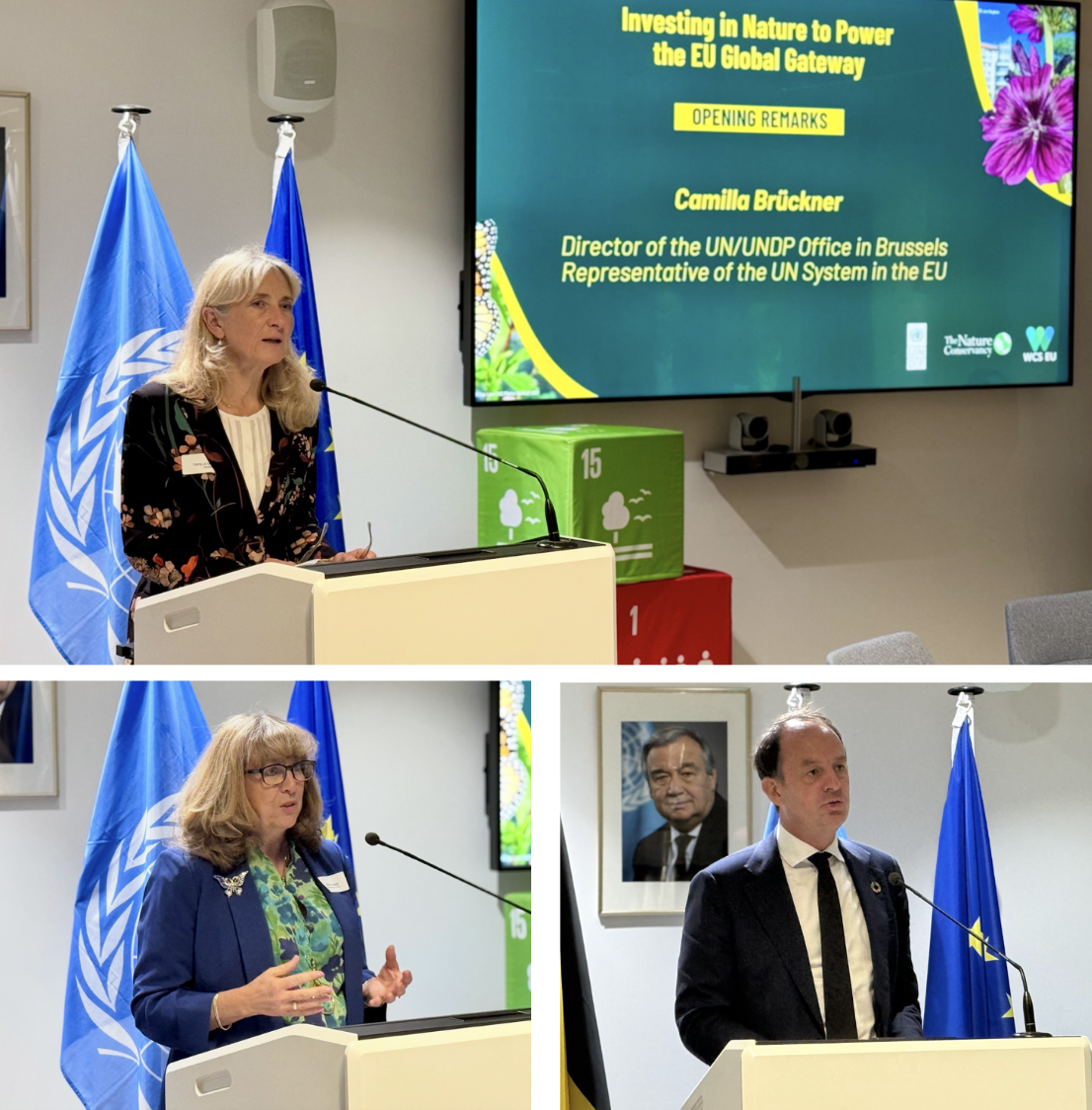 Clockwise from top: Camilla Brückner (UNDP), Jean Van Wetter (Enabel), and Astrid Schomaker (CBD).
Two panel discussions followed, drawing on real-world case studies from implementing partners, governments, and the private sector.
The first panel, moderated by Dr. Janice Weatherley-Singh, Director of WCS EU, examined how investing in nature can stimulate private sector investment and economic benefits. Panelists included Doreen Walsweer-Sore, Expert - Implementation of the Samoa Agreement and the Joint Parliamentary Assembly, Secretariat of the Organisation of African, Caribbean and Pacific States (OACPS), Jessica Wettstein, Global Lead, Climate and Nature, Barry Callebaut Group, François Toussaint, Chief Impact Officer, Envirium Life Sciences, and Jehanne Fabre, Water and Biodiversity Strategy Director, L’Oréal Group.
The discussion underscored a growing recognition by industry leaders that landscapes and associated value chains are vulnerable to climate change and biodiversity loss. Drawing on examples ranging from sustainable cocoa production in Cross River, Nigeria, to organic-certified vanilla sourced from the rainforests of Papua New Guinea, panelists highlighted how the resilience and sustainability of value chains are intrinsically linked to the health of the landscapes in which they operate. Supply chains are not as re-deployable as commonly perceived, their reliance on place-specific infrastructure, inputs, and ecological conditions makes nature conservation a business imperative, not a voluntary commitment.
Furthermore, the right regulatory environment must not only exist but be actively implemented, alongside the right financial incentives, whether through blended financing or other mechanisms. The EU Deforestation Regulation was highlighted as a strong example of the regulatory drive needed to shift private sector investment practices toward nature-positive outcomes.
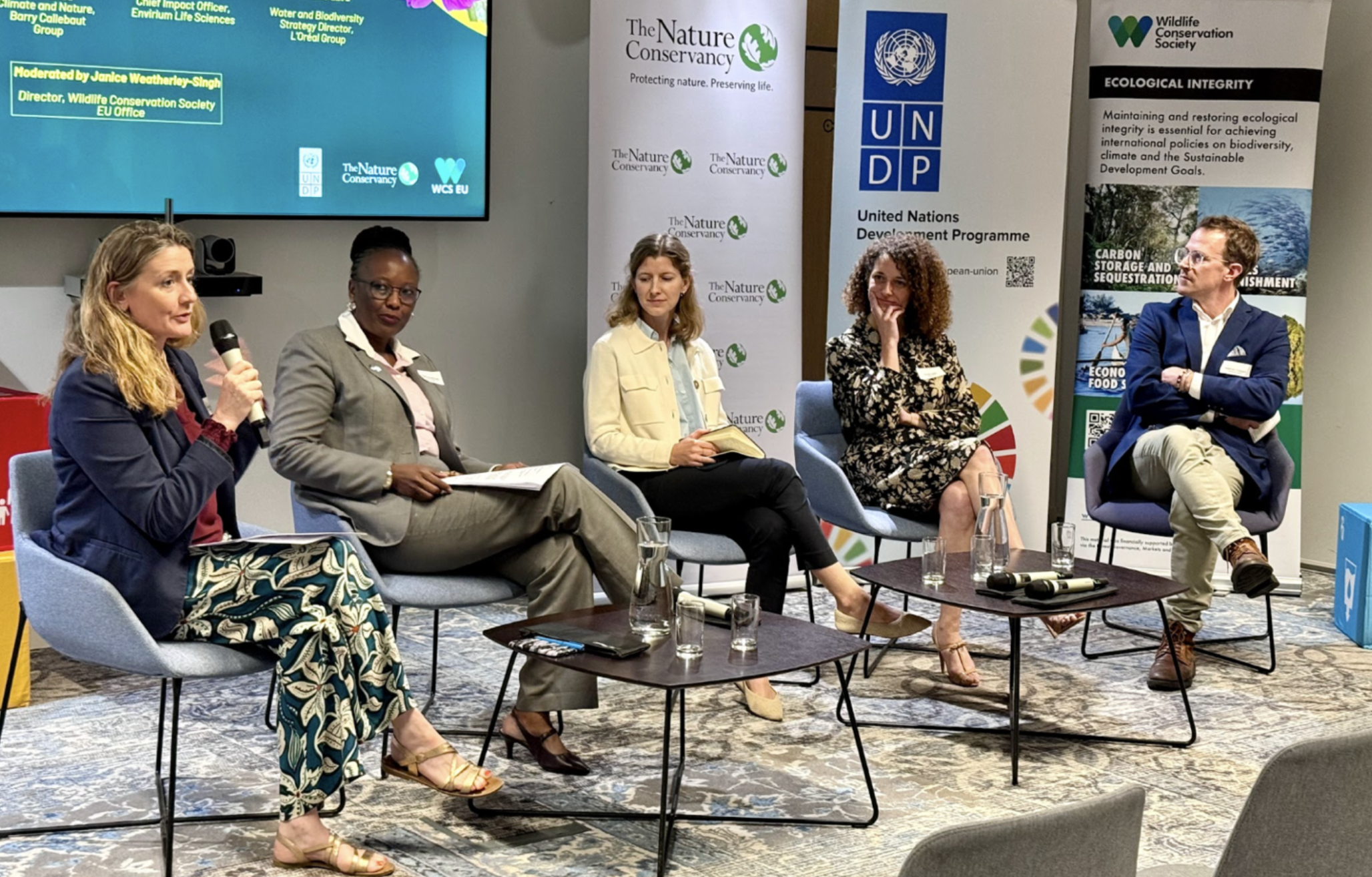 From left to right: Dr. Janice Weatherley-Singh (WCS EU), Doreen Walsweer-Sore (OACPS), Jessica Wettstein (Barry Callebaut Group), Jehanne Fabre (L’Oréal Group), and François Toussaint (Envirium Life Sciences).
Panelists drew on their own experiences to outline what has proven critical to the success of green economy initiatives combining public and private investment. Long-term commitment to particular landscapes, rather than short-term project cycles, emerged as a foundational requirement, alongside strong community ownership and local community capacity to meaningfully engage. Resilience depends on diversifying sources of revenue to those communities, reducing their vulnerability to external shocks. Underpinning all of this is robust scientific collaboration and partnerships, data sharing, and the ability to monitor impacts over time.
The second panel, moderated by Flavia Sollazzo, TNC Europe Policy Director, focused on scaling up private sector investment in nature. Panelists Ines Verleye, Co-chair of the Resource Mobilization Contact Group under the CBD and representing the “Finance for Finance Initiative”, Onno van den Heuvel, Global Lead for Nature Finance at UNDP, and Charlotte Waldraff, Sustainable Finance Advisor at GIZ explored how to move beyond political frameworks to effective implementation at scale.
Mobilizing private capital at a meaningful scale necessitates the active development of enabling conditions. This encompasses the deployment of blended finance, alongside the redirection of incentives, to firmly align market interests with sustainable practices. Many countries currently lack the resources and capacity to implement solutions at scale, making targeted capacity-building a critical next step to unlock greater financing for nature.
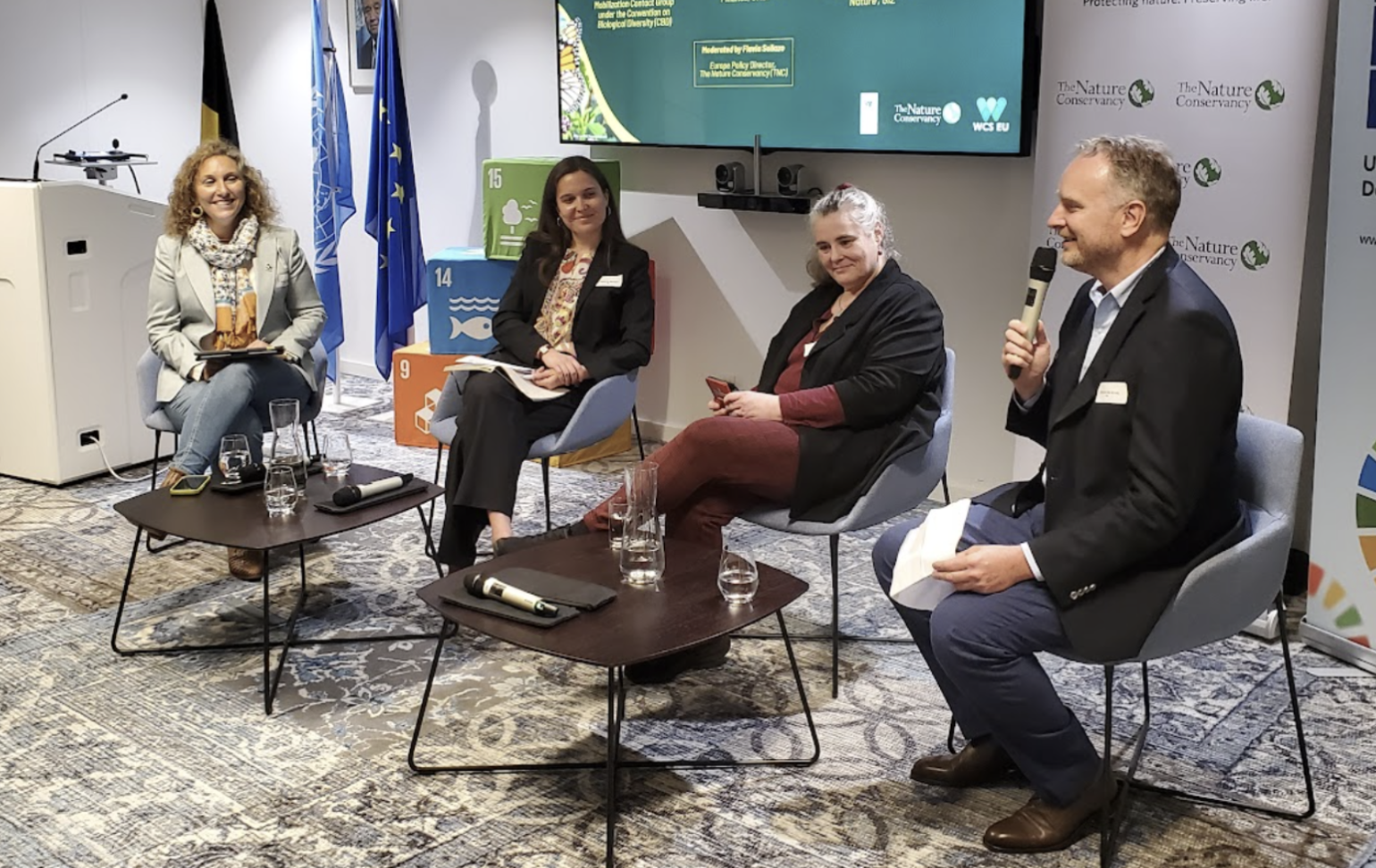 From left to right: Flavia Sollazzo (TNC), Charlotte Waldraff (GIZ), Ines Verleye (Belgian Government), and Onno van den Heuvel (UNDP).
The conversation also highlighted the need to better map and screen private sector financial flows and harmful subsidies, and to scale up initiatives that have taken a landscape approach to sustainable use of natural resources. As one participant observed: there is still significantly more money to be made from destroying biodiversity than from protecting it — a dynamic that the right enabling environments and regulatory incentives must work to reverse.
A key example presented was the Biodiversity Finance Initiative (BIOFIN), a global initiative designed to address the significant challenge of financing biodiversity conservation and now being implemented across more than 130 countries. Launched by the EU and UNDP in 2012, BIOFIN provides technical support to countries to develop and implement comprehensive strategies for biodiversity finance. By leveraging innovative financial mechanisms, improving policy frameworks, and aligning public and private investments with biodiversity objectives, BIOFIN helps countries develop sustainable, context-specific finance solutions. The BIOFIN example was complemented by another example - “Finance for Finance” (FxF) aiming to support the implementation of the National Biodiversity Finance Plans.
The event closed with an interactive session moderated by Marco Arlaud, Senior Advisor for Global Nature Finance at UNDP, and closing statements by Veronika Hunt Šafránková, Head of the Brussels Office of UNEP.
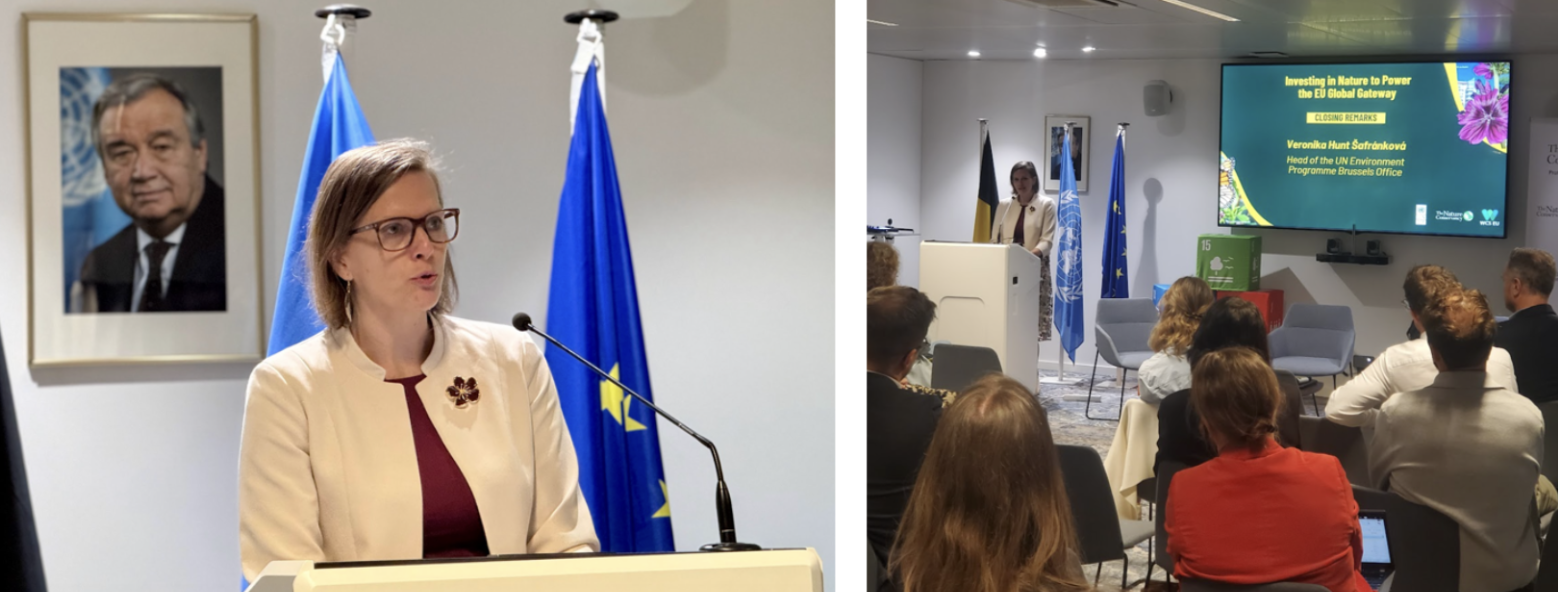 Veronika Hunt Safránková (UNEP) delivering the closing remarks.
The message across the day was clear: biodiversity conservation, climate resilience, sustainable development, and economic prosperity are deeply interconnected and must be advanced through integrated approaches that align environmental, economic, and social objectives.
Investing in nature to power the EU Global Gateway emerged as a key pathway, helping to mobilise investment at scale while ensuring it translates into durable, real-economy outcomes. This includes strengthening economic resilience and improving local livelihoods, while safeguarding the natural systems on which people, health, security, and prosperity depend.